


Recent changes to Facebook’s privacy policy and overall rule system are certainly making life difficult for entrepreneurs. The company’s policies around advertising one’s business on the social network has (once again) changed. If businesses don’t pay Facebook to boost their status, business pages will not be getting their message out. Previously, a business owner would boost a status to spread the word to more people. But, beginning in mid-January, the social network will intensify its efforts to filter out unpaid promotional material in user news feeds. Because of this new rule, even if the page has thousands of fans, a status may never be seen unless it has been boosted. Basically, any business who relies on free status marketing will suffer.
Facebook warned of this in early November 2014 when they explained that the practice of businesses posting free marketing pitches or reusing content from existing ads will suffer “a significant decrease in distribution” once the new policy rolled out. The average small business owner can not afford to pay thousands of dollars to promote their content each month, or, at the very least, will need to reevaluate their marketing budget to account for these changes. Considering that more than 80% of small companies who use social media to promote their businesses list Facebook as their top marketing tool, this new policy means a major shift in many social media marketing plans.
Many business owners are going to need to look elsewhere for effective and affordable options. Facebook stands to lose a lot of small business entrepreneurs as doing business on the social network becomes more expensive. So why are they doing it? Facebook’s vice president of small business, Dan Levy, explained the reasoning behind this move. He claims Facebook’s paid-advertising options have become more effective over time. He suggests companies view Facebook as a tool to “help them grow their businesses, not a niche social solution to getting more reach or to make a post go viral.” Organic reach, Levy says, is only one of several reasons companies benefit from having a presence on Facebook. The network has over 1 billion hits per month. Just by being on the network, the likelihood that your business will be found increases. This makes sense, and many small-business owners say they accept that they will have to pay to market their businesses on Facebook. Any good marketing campaign costs money. When looking at an online marketing strategy, the use of free online marketing campaigns has not always resulted in positive responses. Todd Bairstow, partner at the online-marketing firm Keyword Connects, explains that the strategy of attracting fans and “likes” on Facebook using unpaid posts “ultimately failed for almost everyone we know.” Facebook may help “spread the word”, but using the network to market your business is not going to necessarily result in sales or new business.
This leaves small business owners with a decision to make. Do you restructure your marketing budget to include paid promotions on the network where you’ve built your brand and have a strong following? Or do you search for other options? Many are focusing their efforts and online marketing budgets now on boosting their Google rankings. This is a more complicated process, as well as more time consuming, but the overall results may be better for small business owners. For more information on how to best utilize search engine optimization, visit Google’s page dedicated to this topic by clicking How a Google Search Works. Some business owners may choose to leave Facebook altogether and focus their time and energy on other outlets. Google Plus is option. Not only has G+ grown to over 540 million active members, it has the power of the Google search engines behind it, resulting in posts showing up in a Google search. Also, it’s known to generate as much brand engagement as Facebook.
Whatever you decide, just make sure it’s something that you can afford and can commit to. There are many options out there. Now’s the time to make informed decisions for both yourself and your business. Good luck!
If social networks were perfect, they would require everyone to apply for membership before opening an account. So many people seem to think opening an account on a social media network allows them to throw common courtesy out the window, or turn into obnoxious individuals who no longer can seem to keep their every mundane thought or experience to themselves. We’ve become a society filled with overly self-involved people thinking our daily lives are so interesting that every action has now become newsworthy. Enter Facebook, a place where this behavior spreads like wildfire. Though it is an amazing tool for business when it comes to online marketing, the beginnings of the network were in common personal account holders, and therein is where the problems lie. Following are 10 things that have now changed because of the most popular social network.
Before Facebook: Enjoy the moment while you’re in it and don’t worry who knows about it.
After Facebook: Post about the amazing/wonderful/inspiring moment while we are having it. It is now ok to leave that moment to log onto Facebook, add the post, and then of course continue to check in frequently to see if anyone has noticed it.
Before Facebook: Debates focused on facts when face to face. When an uneducated debater entered, they were quickly drowned out by the more intelligent argument, especially with no keyboard and enter button to bring them back into the conversation.
After Facebook: Facebook seems to give people who would never open their mouths to engage in a face-to-face political debate the courage to not only rant about their own political ideologies, but to also criticize others in a way they just would not do in person.
Before Facebook: There’s always been slacking in the workplace, but BF we were better able to hide our bad habits.
After Facebook: Many work places ban Facebook usage, yet grown-ups still find time to log onto the social network during the workday. With co-workers as friends on the network, our slacking is not so secret anymore.
Before Facebook: We dealt with bad weather or bad traffic and trudged on. There’s certainly more in life to complain to others about than that!
After Facebook: Every rainy day, snowstorm, traffic jam, etc. is now posted on Facebook. Even worse, others chime in (“I know. This rain is ruining my hair!”)
Before Facebook: Couples would sit next to one another, hold hands, lay a head on a shoulder and say “I love you.” And no one else needed to know about it.
After Facebook: Couples now send messages to one another (“You look so cute sitting there, honey. I love you.”) Not only is this ridiculously impersonal and unromantic, but it’s just not appropriate or necessary to bring the rest of the world into the room.
Before Facebook: Work-out, sweat, shower and get on with the day. The only ones “in the know” were the other members at the gym. Did I ever feel the need to call or email a friend and tell them I just finished exercising my butt off? Not that I remember.
After Facebook: “I’m at the gym now.” “I just finished a 4 mile run.” “I am so sore after bootcamp!” Thanks for sharing. Are we trying to inspire others, or just let others know we’re in better shape than them because we’re now working out and they’re on Facebook reading about it?
Before Facebook: Most of us used to practice humility and modesty. Did we do something pretty great? Sure. Did we share it? Yes, with our close friends and loved ones. Did we tell strangers or people we really didn’t know and who really didn’t know us? Um, no.
After Facebook: Everyone with a Facebook page can now gloat and glorify every action of their lives, and not feel embarrassed. The worst that can happen is friends will soon become annoyed with the arrogance and either hide your posts or defriend you. Others, like myself, may keep the relationship going only to complain and sigh in exasperation everytime I see a post about how amazing and wonderful you really are. It’s almost like that drive by the car accident phenomenon. We really don’t want to look but we always do.
Before Facebook: We were bored so we’d eat, or watch tv, or read a book. I can’t recall one time I ever felt the need to pick up a phone and call someone to tell them I not only just ate dinner, but I took a photo of it and would send it to them if they’d like to see it. Honestly. Not once.
After Facebook: Now when we’re bored we post every mundane experience of our day as if it’s headline news. When we’re bored and really have nothing to say, we can jump on Facebook and tell our hundreds of friends what we just snacked on, or all about our trip to Wal-Mart, or the fact that our child stayed home sick, or any other of the hundreds of mundane activities that make up a typical day. But many people will respond which only feeds into the offenders desire to continue this behavior.
Before Facebook: Card shopping. Phone calls. Hearing your friends’ voice. Hearing him laugh as you chat about when you celebrated his 21st birthday with him. A personal connection behind every well wish and greeting.
After Facebook: We post “Happy Birthday, buddy!” on his wall, feeling this action takes the place of a phone call or (heaven forbid) buying a card and mailing it. Thanks to Facebook, contrary to the popular belief that it’s brought us closer, it’s actually distanced us from one another. It’s only a matter of time before Hallmark goes out of business.
Before Facebook: Yes, common decency has always lacked in certain individuals. But BF, the offenses were limited to the few friends they had and were certainly not clogging up my newsfeed. Plus the embarrassing party photos lived within someone’s photo album (remember those?) and did not live on the internet for the entire world to see.
After Facebook: Sadly, on Facebook, this is sometimes hard to find. Thanks to the fact that everyone owns a camera and can easily post photo albums for hundreds of people to view at once, such as women after multiple pregnancies posing in a 2 piece bathing suit. Really? Though we know we look good “for our age”, the old high school boyfriend checking out that picture is thinking about the far cry our bodies have come from what they were in high school. Or maybe we’re hoping to hear “Hot Mama!” But why? Even worse, the tens of thousands of party pictures, posing with a drink or two in hand, abnormally large smiles or half closed eyes. Is this really how we want the world to see us? Are we looking our best? No.
I’m not against Facebook. I enjoy hearing about a friend’s pregnancy, or seeing pictures of the children I’ll never get to meet in person, or seeing old college friends enjoying their honeymoon, or reading interesting articles someone felt was worth sharing. I enjoy the morning after a birthday and seeing the many messages sprawled across my Wall. Absolutely. But, like anything, while it can be used for good, some choose to abuse it and, in many cases, worsen the experience for us all. I’ve been an offender myself at times. I do have a choice and I know it. I can hide the agitator. I can defriend the offender. Or I can drive by the accident and take a quick peek, no matter how much I didn’t want to. Which is typically what I do.
Facebook is making their new timeline mandatory on March 30th…just 21 days from now. What’s important as a business owner is knowing what these changes entail, and developing a game plan to make the most of the roll-over. For starters, let’s break down the top of the page since this is where your audience will land and it’s our best chance for making a positive first impression.
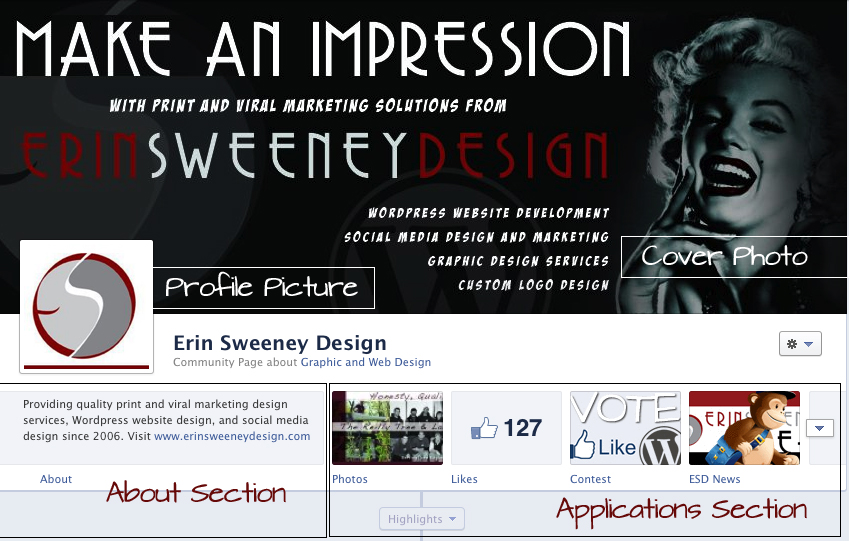
The top of the page is broken down into 4 very important elements. Before you publish your page in the new timeline, be certain that all 4 elements have been considered and are ready to go.
The cover photo is the first impression you will make on the viewer. It needs to be visually striking and reflect your brand. One very important thing to consider is Facebook does not allow for any sort of call to action to be included in this cover image (i.e., “Click to like my page”) so be certain when you design the cover photo that it refrains from including a call to action. This also would include adding phone numbers and/or web addresses as part of the design. Any element that would require the user to perform another task is not allowed. Instead focus on a design that will grab the viewers attention and influence them to become a fan. The dimensions for the cover photo are 851 pixels x 315 pixels.
This is basically a thumbnail. It is what will be seen on the newsfeed when you post from your business page. Be sure it includes your logo. It’s preferable that the logo is not cropped but displayed in full. The dimensions for the profile picture are 180 pixels x 180 pixels.
With the new timeline, this section is now prominent so take advantage of that. Previously this section was hidden in the sidebar. It is now a main focus on your page so be sure to use this opportunity to sell your brand! Include contact information here that could not be included on the cover photo such as a web address.
Another great improvement with the new timeline is the Apps section. Again, a section that was previously hidden is now front and center so utilize this to best sell your page and gain fans. The Photos app is standard and will always come first. At least for now that is one app we can not change. But we can move all of the other apps around where we want them so be sure the ones that are showing in the top row are the ones you want the viewer to notice. There is a drop down arrow to view additional apps that are not in the top 4, but the majority of your viewers will not click on this, so focus your efforts on the top line. Be sure to utilize relevant images for each app so they stand out.
Some things to thank Facebook for as we transition our business page over to the new timeline:
The top of the page will get the viewers attention. But there’s more to your business page than what’s up top. We need to move down a bit to see the other changes coming our way.
The new timeline makes the Friends section more prominent. This section will display friends of the viewer that already like the page. Most people are more likely to follow the crowd. If their friends like the page, chances are they will to!
The new timeline allows us to pin a post. This means a post can be featured at the top of the page for a week at a time. When someone visits the page, the pinned post will be displayed at the top, keeping it fresh without having to create multiple postings. This is useful when running a contest on your page. To pin a post, click on the Edit or Remove link in the upper right hand corner and click “Pin to Top.”
When you highlight a post, it creates a double-width of that post. This is a great way to jazz up your wall with cool photos and video. To highlight a post, click the star in the upper right hand corner. Again, this works well with visually appealing imagery to really decorate your wall.
A few more things to thank Facebook for…
With all this new progress, one thing remains the same: the newsfeed is still king. Most of your fans (9 out of 10 people only visit your page once) will see your brand through the newsfeed. What you post is what they see. Your Facebook marketing strategy needs to continue to focus on how you moderate, comment and interact with fans.
Take time to develop your game plan. Once you publish your page in the new timeline, there’s no going back. Enjoy the new changes and make the most of them. Good luck!

You made the move to online marketing and activated a business page on Facebook. Now what? Outside of optimizing the page with information and making it visually interesting, what else is important? Utilizing your wall through smart posting. How do you post to encourage page fans to engage with your page, and therefore spread the word? Below are 5 Top Facebook Tips that you should be practicing.
Do not preach or sell to your fans. I know it may be instinctual for many to want to sell their business services. As a small business owner, we’re our own megaphone. If we’re not talking about ourselves, who is? But it can turn others off. Instead engage your fans by offering special deals in a post (promotes the business and gives fans a deal!), discuss a current event, offer an inspirational quote, etc. Also, a good way to sell yourself through a post without being too pushy is to tie it to something on your site. Your fan is both engaged AND on your website. It’s a win-win.
Many Facebook business page owners wonder how often they should post. Most experts agree 3-5 times per day is optimal. That may seem excessive, but if you develop a content calendar (a schedule that serves as a roadmap of posting options such as photos, questions, blogs, promos, etc.), it can be done. Set aside 5 minutes a few times daily (set a timer on your phone to remind you) to log on and post. The more your message appears on other Facebook walls, the better!
In other words, don’t make a statement. Ask a question. Tell people to click the Like button. Ask for comments on your post. Tell them to watch a video you’ve posted or direct them to your website and request feedback.
What you do is great. You’re talented. You have a lot to offer. You enjoy your business and want to keep doing it so you need to promote your services to gain more customers. So, yes, it’s ok to highlight yourself now and then. A good rule of thumb: If you are posting 5 times per week, make 4 of the posts helpful or fun information for your fans and allow 1 to be a self-promotion post. Remember, self-promotion is good when in limited amounts.
With 850 million people on Facebook (and climbing), there is a heck of a lot of posting going on. Most Facebook users are only on sporadically each day. Make their time online enjoyable. If most of your fans are clients, offer free tips and advice that they can use. Post entertaining information, pictures, video, links. Make your fans look forward to a new post from your business!
Remember, Facebook is all about conversation. For business owners, it’s an extension of your brand and another opportunity to market your business to an audience. Put your personality into your wall posts and consider these tips when posting on your page. You’ll find you’ll gain a lot more Friends along the way. Good luck!

 Facebook has an incredible reach for small business when it comes to viral marketing. With approximately 1 in every 7 people in the world on Facebook, your marketing strategy needs to include fully utilizing the offerings of Facebook to market your business. One of these offerings is the ability to host an Event.
To create an Event on Facebook, you must be logged in to your personal profile (Pages can’t invite people to an Event.) Click on ‘Events’ on the left side bar. A page will open up listing any upcoming Events associated with your account. To create your own, click +Create an Event. Very important. When creating an Event, many hosts skip the part about being able to upload a photo to replace the default calendar graphic that Facebook gives us. Using a photo related to the Event will help promote it. Something that just takes a second can make a big difference.
OK. Now that you have the Event started and a cool photo up, next be sure to accurately describe the Event. You can make it a public event by checking “Anyone can view and RSVP” or keep it only to those you choose by unchecking this box. You can also choose to show the guest list or hide it. Depending on the Event, your needs may vary. Once all the Event details have been included, it’s time to promote the Event.
Now the Event is out there. You’re getting some responses. What do you do next? Be sure to interact with the attendees. Answer any questions they may have about the upcoming Event. Continue to promote it by referring to it in a status update and sending out tweets. Ask others to help you promote the Event through their own status updates and on their Twitter page. There’s no better way to drive up attendance than through constant promotion. Get the word out.
Once the Event has passed and proved to be a huge success, it’s no time to rest. Follow up. Post photos and video from the Event on your Page. Ask attendees to tag themselves in the photos and make comments about the Event. This spreads word of the Event by posting the photo or comment on their Walls. And be sure to thank attendees. Though we’re all online, the old school rules of politeness still exist. As long as everyone had a positive experience, they’ll keep coming back.
Attempt to include Events, whether live or virtual, in your marketing plan at least 4 times per year. You’ll see your exposure grow, both online and out in the real world where it counts.